Maximize 2026 Education Tax Credits: A U.S. Guide for Students & Parents

Navigating the complex world of college financing can be daunting, but understanding and leveraging education tax credits can significantly ease the financial burden. For the 2026 tax year, students and parents in the United States have several valuable opportunities to reduce their tax liability by up to $2,500 through various education tax credits. This comprehensive guide will walk you through the essential details, eligibility requirements, and strategies to maximize these crucial benefits.
The cost of higher education continues to rise, making every available saving opportunity critical. Whether you’re a student paying your own way, a parent supporting your child’s academic journey, or an adult returning to school, these credits are designed to help offset tuition, fees, and other qualified educational expenses. By planning ahead and meticulously understanding the rules, you can ensure you claim every dollar you’re entitled to.
In this article, we’ll delve into the two primary federal education tax credits: the American Opportunity Tax Credit (AOTC) and the Lifetime Learning Credit (LLC). We’ll also touch upon other related deductions and savings plans that can complement these credits, offering a holistic approach to managing educational costs. Our goal is to demystify these tax provisions, providing clear, actionable insights so you can confidently prepare your 2026 tax return and secure the maximum possible savings. Let’s explore how to effectively utilize Education Tax Credits 2026.
Understanding the American Opportunity Tax Credit (AOTC)
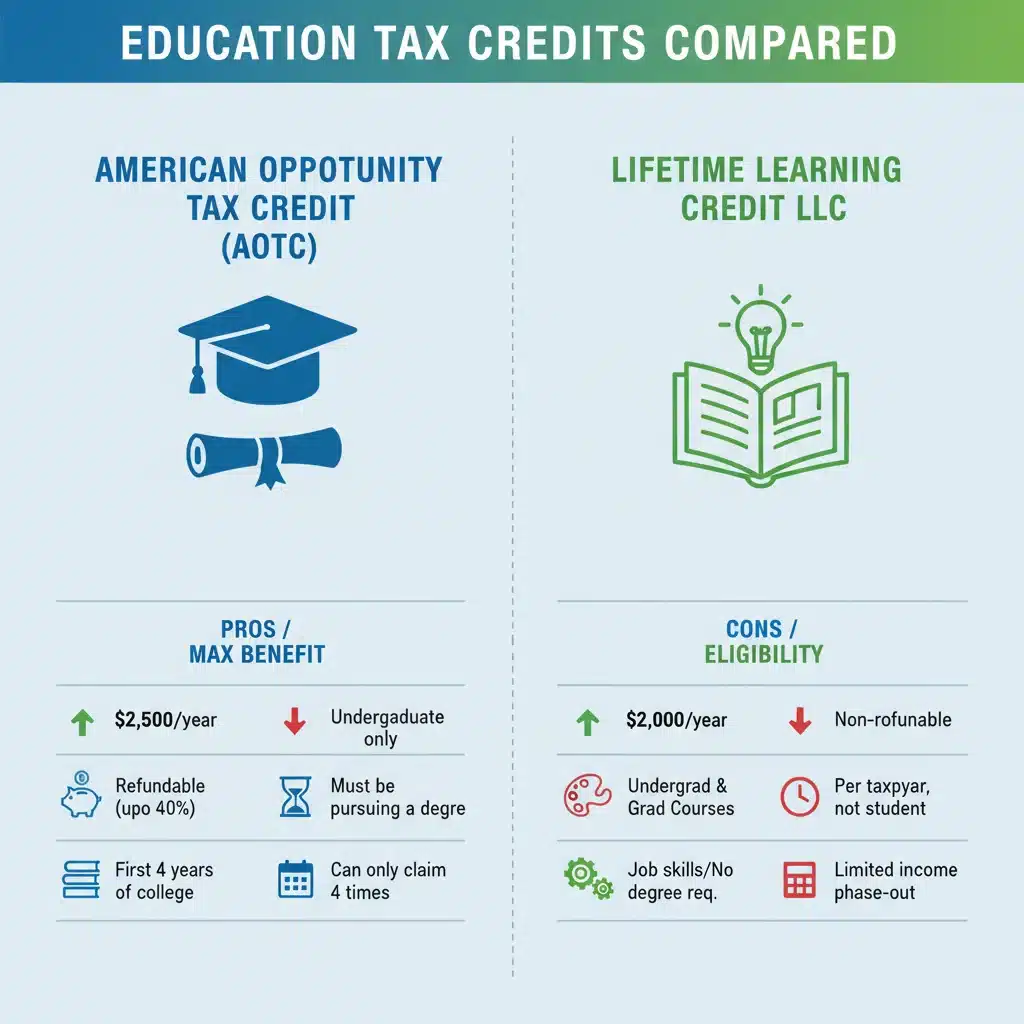
The American Opportunity Tax Credit (AOTC) is arguably the most generous of the federal education tax credits, offering substantial assistance to eligible students and their families. For the 2026 tax year, the AOTC can provide a maximum annual credit of up to $2,500 per eligible student. This credit is particularly attractive because it is partially refundable, meaning that if the credit reduces your tax liability to $0, you can still receive 40% of the remaining credit (up to $1,000) back as a refund.
Eligibility Requirements for AOTC
To qualify for the AOTC, both the student and the educational program must meet specific criteria:
- Eligible Student: The student must be pursuing a degree or other recognized educational credential. They must be enrolled at least half-time for at least one academic period beginning in the tax year at an eligible educational institution.
- Academic Level: The student must be in their first four years of higher education (i.e., not have completed the first four years of post-secondary education before the beginning of the tax year).
- Felony Drug Conviction: The student must not have been convicted of a felony drug offense.
- Number of Claims: The AOTC can only be claimed for a student for four tax years. This limit applies even if the student changes schools or majors.
Qualified Education Expenses for AOTC
The AOTC covers a broader range of expenses than some other education credits. Qualified expenses include:
- Tuition and Fees: Amounts paid to an eligible educational institution for the student’s enrollment or attendance.
- Course Materials: Books, supplies, and equipment needed for a course of study, whether or not purchased from the educational institution. This is a key differentiator from the Lifetime Learning Credit.
It’s important to note that room and board, transportation, and similar personal living expenses are generally not considered qualified education expenses for the AOTC.
Income Limitations for AOTC
Like many tax benefits, the AOTC is subject to income limitations. For 2026, these limits are likely to be similar to previous years, adjusted for inflation. Typically, the credit is phased out for taxpayers with a modified adjusted gross income (MAGI) above certain thresholds. For single filers, the phase-out usually begins around $80,000 to $90,000, and for married couples filing jointly, it’s typically around $160,000 to $180,000. It’s crucial to check the most current IRS guidelines for the exact 2026 figures as they become available.
How the AOTC Works
The AOTC is calculated based on 100% of the first $2,000 in qualified education expenses and 25% of the next $2,000 in qualified expenses. This means that to receive the full $2,500 credit, you would need at least $4,000 in qualified expenses. Remember, up to $1,000 of the credit is refundable, making it a powerful tool for families with lower tax liabilities.
Exploring the Lifetime Learning Credit (LLC)
While the AOTC is geared towards students pursuing their initial undergraduate degrees, the Lifetime Learning Credit (LLC) offers a valuable alternative for a wider range of educational pursuits. The LLC is particularly beneficial for graduate students, those taking courses to acquire job skills, or individuals who have already completed their first four years of college. For the 2026 tax year, the LLC provides a maximum nonrefundable credit of up to $2,000 per tax return.
Eligibility Requirements for LLC
The eligibility criteria for the LLC are more flexible than the AOTC:
- Eligible Student: The student must be taking courses toward a degree or for job skills improvement at an eligible educational institution.
- Enrollment Level: There is no requirement for the student to be enrolled at least half-time. Even a single course can qualify.
- Academic Level: The LLC can be claimed for undergraduate, graduate, and even professional degree courses. There is no limit on the number of years it can be claimed.
- Felony Drug Conviction: There is no felony drug conviction restriction for the LLC.
Qualified Education Expenses for LLC
The types of expenses that qualify for the LLC are similar to the AOTC but with a key difference regarding course materials:
- Tuition and Fees: Amounts paid for enrollment or attendance at an eligible educational institution.
- Course-Related Books, Supplies, and Equipment: These only qualify if they are required to be purchased from the educational institution as a condition of enrollment or attendance. This is a stricter requirement than the AOTC.
Again, personal living expenses such as room and board, insurance, medical expenses, and transportation are not qualified expenses for the LLC.
Income Limitations for LLC
The LLC also has income limitations, which are generally lower than those for the AOTC and are subject to phase-out. For 2026, these MAGI thresholds will be adjusted for inflation. Typically, the phase-out range for single filers is lower than the AOTC, and similarly for married couples filing jointly. It is essential to consult the most up-to-date IRS publications for the specific 2026 income thresholds to determine your eligibility for this Education Tax Credits 2026 benefit.
How the LLC Works
The LLC is calculated as 20% of the first $10,000 in qualified education expenses, up to a maximum credit of $2,000. Unlike the AOTC, the LLC is nonrefundable, meaning it can reduce your tax liability to $0, but you won’t receive any portion of the credit back as a refund if it exceeds your tax liability.
Choosing Between AOTC and LLC: A Critical Decision
One of the most important aspects of maximizing your Education Tax Credits 2026 is understanding that you cannot claim both the AOTC and the LLC for the same student in the same tax year. You must choose the credit that provides the greatest benefit. Here’s a brief comparison to help you decide:
- AOTC: Best for undergraduate students in their first four years of college, enrolled at least half-time, who have significant qualified expenses (at least $4,000) and whose income falls within the higher MAGI limits. The refundable portion is a major advantage.
- LLC: More flexible for graduate students, those taking a single course, or those pursuing job skills. It has no limit on the number of years it can be claimed and no half-time enrollment requirement. However, it’s nonrefundable and has lower income limits.
Often, the AOTC provides a larger credit, especially due to its refundable nature. However, if a student doesn’t meet the AOTC’s strict requirements (e.g., beyond their fourth year, not enrolled half-time, or taking courses for professional development), the LLC becomes the default and still valuable option. Always calculate both scenarios if eligible to ensure you select the most advantageous credit.

Other Education Tax Benefits to Consider for 2026
Beyond the AOTC and LLC, several other tax benefits can help offset education costs. While they may not be Education Tax Credits 2026 in the same vein, they offer valuable deductions and savings opportunities.
Student Loan Interest Deduction
If you’re paying interest on qualified student loans, you may be able to deduct up to $2,500 of the interest paid each year. This deduction is an above-the-line deduction, meaning it reduces your taxable income regardless of whether you itemize deductions or take the standard deduction. Income limitations apply, and the loan must have been used solely to pay for qualified education expenses.
Tuition and Fees Deduction (Expired/Suspended in Recent Years)
Historically, there was a tuition and fees deduction, which allowed taxpayers to deduct up to $4,000 of qualified education expenses from their gross income. However, this deduction has been subject to expiration and suspension in recent tax years, often replaced by the expanded AOTC and LLC. It’s crucial to verify if this deduction is reinstated or available for the 2026 tax year when preparing your returns, as tax laws can change frequently. Always check the latest IRS guidelines.
Tax-Free Scholarships, Fellowships, and Grants
Generally, scholarships, fellowships, and grants are tax-free if the student is a degree candidate and the funds are used for qualified education expenses (tuition, fees, books, supplies, and equipment required for courses). However, if any portion of these funds is used for non-qualified expenses, such as room and board, it becomes taxable income.
529 Plans: A Powerful Savings Tool
While not a direct credit, 529 plans are an excellent way to save for future education expenses. Contributions to a 529 plan grow tax-deferred, and qualified withdrawals for education expenses are tax-free at the federal level (and often at the state level). Qualified expenses for 529 plans are broader than for tax credits, including tuition, fees, books, supplies, equipment, and even room and board for students enrolled at least half-time. Some states even offer a tax deduction or credit for contributions to their 529 plans, further enhancing their appeal for Education Tax Credits 2026 planning.
Coverdell Education Savings Accounts (ESAs)
Coverdell ESAs allow you to contribute up to $2,000 per year for a beneficiary under age 18. Earnings grow tax-free, and distributions are tax-free if used for qualified education expenses. ESAs offer more flexibility than 529 plans in terms of investment options and can be used for qualified elementary and secondary education expenses in addition to higher education. However, they have stricter income limits for contributors.
Navigating the Maze: Key Considerations for Claiming Education Tax Credits 2026
Successfully claiming education tax credits requires careful attention to detail and thorough record-keeping. Here are some critical points to keep in mind:
Who Can Claim the Credit?
Generally, either the student or the parent can claim the education credit, but not both for the same student in the same year. If the student is claimed as a dependent on their parents’ tax return, only the parents can claim the education credit for that student. If the student is not claimed as a dependent, they can claim the credit themselves.
Form 1098-T: Your Essential Document
Eligible educational institutions are required to provide Form 1098-T, Tuition Statement, to enrolled students. This form reports the amounts billed or received for qualified tuition and related expenses. While the 1098-T is a crucial document, it may not always reflect all your qualified expenses (e.g., books purchased elsewhere for AOTC). It’s vital to keep all receipts and records of education expenses.
Record Keeping is Paramount
Maintain meticulous records of all tuition payments, fees, book purchases, and any other qualified education expenses. This includes receipts, invoices, canceled checks, and bank statements. In case of an IRS audit, clear and organized documentation will be your best defense.
Understanding Modified Adjusted Gross Income (MAGI)
Both the AOTC and LLC have MAGI limitations. Your MAGI is your adjusted gross income (AGI) with certain deductions added back. It’s important to calculate your MAGI accurately to determine if you qualify for the full credit, a partial credit, or no credit at all. Tax software or a tax professional can help with this calculation.
No Double Dipping
You cannot use the same qualified education expenses to justify more than one tax benefit. For example, if you use expenses to claim the AOTC, you cannot use those same expenses to also claim the LLC or take a student loan interest deduction for interest paid on a loan used for those same expenses. You must choose which benefit provides the most advantage.
When to Claim the Credit
The credit is claimed in the tax year the expenses were paid, even if the academic period begins in the next tax year (e.g., paying for spring 2027 classes in December 2026). However, the academic period must begin in the current tax year or the first three months of the next tax year.
Strategies for Maximizing Your Education Tax Credits 2026
To ensure you’re getting the most out of these valuable tax benefits, consider the following strategies:
1. Plan Your Payments
If you’re close to the income phase-out limits, or if you’re trying to meet the $4,000 expense threshold for the AOTC, strategically timing when you pay tuition or buy books can make a difference. For instance, if an academic period begins in January 2027, but you pay tuition in December 2026, those expenses can typically be counted for your 2026 tax return.
2. Coordinate with Other Benefits
If you’re receiving tax-free educational assistance, such as scholarships or grants, you cannot use those funds as qualified expenses for tax credits. However, you can strategically allocate these funds. For example, if a scholarship covers tuition, you might use personal funds for books and supplies, which could then qualify for the AOTC. The key is to ensure that the expenses used for the credit were not paid for with tax-free funds.
3. Consider Your Filing Status
Your filing status (single, married filing jointly, head of household, etc.) directly impacts your MAGI and, consequently, your eligibility for these credits. Married couples filing separately generally cannot claim education credits. Always consider how your filing status affects your overall tax picture.
4. Review Student Status
For parents, determine if you can claim your child as a dependent. If so, you will likely be the one to claim the education credit. If your child is not your dependent, they can claim the credit themselves. This decision can have significant tax implications for both parties.
5. Utilize Tax Software or a Professional
Tax software can guide you through the process of claiming education credits, often determining which credit is most beneficial for your situation. For more complex scenarios, or if you have any doubts, consulting a qualified tax professional is highly recommended. They can provide personalized advice and ensure compliance with all IRS regulations, helping you maximize your Education Tax Credits 2026.
6. Understand Recapture Rules
In some rare cases, if a student receives the refundable portion of the AOTC and then later determines they were not eligible, the IRS may require a recapture of the credit. Understanding these potential scenarios is important, though uncommon for most taxpayers.
Common Pitfalls to Avoid
While Education Tax Credits 2026 offer significant savings, certain mistakes can lead to denied credits or even penalties. Be aware of these common pitfalls:
- Incorrectly Calculating MAGI: Failing to accurately calculate your Modified Adjusted Gross Income can lead to claiming a credit you’re not eligible for, or missing out on one you are.
- Lack of Documentation: Not keeping thorough records of all qualified expenses is a common reason for credit denial during an audit.
- Claiming Both AOTC and LLC for the Same Student: Remember, it’s one or the other per student per year.
- Claiming Expenses Paid with Tax-Free Funds: You cannot use scholarship money or other tax-free aid to justify a credit.
- Incorrectly Determining Student Dependency: Who claims the student as a dependent dictates who can claim the education credit. Make sure this is clear between parents and students.
- Missing Deadlines: While not directly related to the credit itself, ensuring your tax return is filed on time is crucial to receiving any refund or benefit.
- Ignoring State-Specific Benefits: Some states offer their own education tax credits or deductions. Don’t forget to investigate these for additional savings.
The Future of Education Tax Benefits
Tax laws are always subject to change, and education tax benefits are no exception. While the AOTC and LLC have been relatively stable for several years, it’s always wise to stay informed about potential legislative changes that could impact the 2026 tax year and beyond. The IRS typically releases updated guidance and publications annually, and these are your best resources for the most current information.
As you plan for the 2026 tax year, make it a priority to visit the IRS website or consult with a tax professional. Early planning allows you to make informed decisions about tuition payments, savings strategies, and how to best position yourself or your dependent student to take full advantage of all available Education Tax Credits 2026.
Conclusion: Unlock Your Education Savings
The journey through higher education is an investment, and Education Tax Credits 2026 are designed to make that investment more manageable. By understanding the nuances of the American Opportunity Tax Credit and the Lifetime Learning Credit, along with other related deductions and savings plans, you can significantly reduce the financial burden of college. Remember to meticulously track your expenses, understand the eligibility requirements, and choose the credit that offers the maximum benefit for your unique situation.
Whether you’re a student embarking on your academic career or a parent supporting a loved one’s educational pursuits, taking the time to master these tax provisions will translate into substantial savings. Don’t leave money on the table; empower yourself with knowledge and ensure you claim every eligible dollar. With careful planning and informed decisions, the dream of affordable education is well within reach.
Start preparing now for your 2026 tax return—gather your documents, review the criteria, and consider seeking professional advice to ensure you fully capitalize on all available Education Tax Credits 2026.