Retirement Planning 2026: Bridge the Gap with 7% More Contributions

Increasing your monthly retirement contributions by 7% from 2026 onward offers a tangible path to significantly enhance your financial readiness for the future, ensuring a more secure retirement.
Are you looking ahead to your golden years and wondering if your current savings trajectory will truly suffice? The landscape of retirement planning is constantly evolving, and as we approach 2026, it’s more critical than ever to assess and adjust your strategy. This article will delve into how a focused, strategic increase in your monthly contributions can dramatically impact your future financial security, specifically focusing on how to bridge the gap with a 7% increase in your monthly contributions.
Understanding the Retirement Savings Gap in 2026
The concept of a retirement savings gap refers to the difference between the amount an individual has saved for retirement and the amount they will actually need to maintain their desired lifestyle. As we navigate 2026, several economic factors, including inflation, market volatility, and rising healthcare costs, continue to widen this gap for many Americans. Recognizing this disparity is the crucial first step toward effective financial recalibration.
Many individuals find themselves behind schedule, often due to unforeseen expenses, career changes, or simply underestimating the true cost of a comfortable retirement. The average American may need more than they anticipate, especially with increased longevity pushing the boundaries of typical retirement durations. This makes proactive adjustments, such as increasing contributions, not just beneficial but often essential.
Inflation and Its Impact on Future Purchasing Power
Inflation erodes the purchasing power of your savings over time, meaning that a dollar today will buy less in the future. This is a significant consideration for long-term retirement planning.
- Cost of Living: Future expenses for housing, transportation, and daily necessities will likely be higher.
- Healthcare Costs: Medical expenses are a major concern for retirees and are projected to continue rising.
- Lifestyle Maintenance: Maintaining your desired lifestyle in retirement requires substantially more capital than many initially project due to inflationary pressures.
By understanding these underlying economic forces, you can better appreciate the necessity of making strategic adjustments now. A 7% increase in monthly contributions isn’t just an arbitrary number; it’s a measurable step towards counteracting these pervasive financial challenges and securing a more robust retirement.
The Power of a 7% Increase: A Tangible Impact
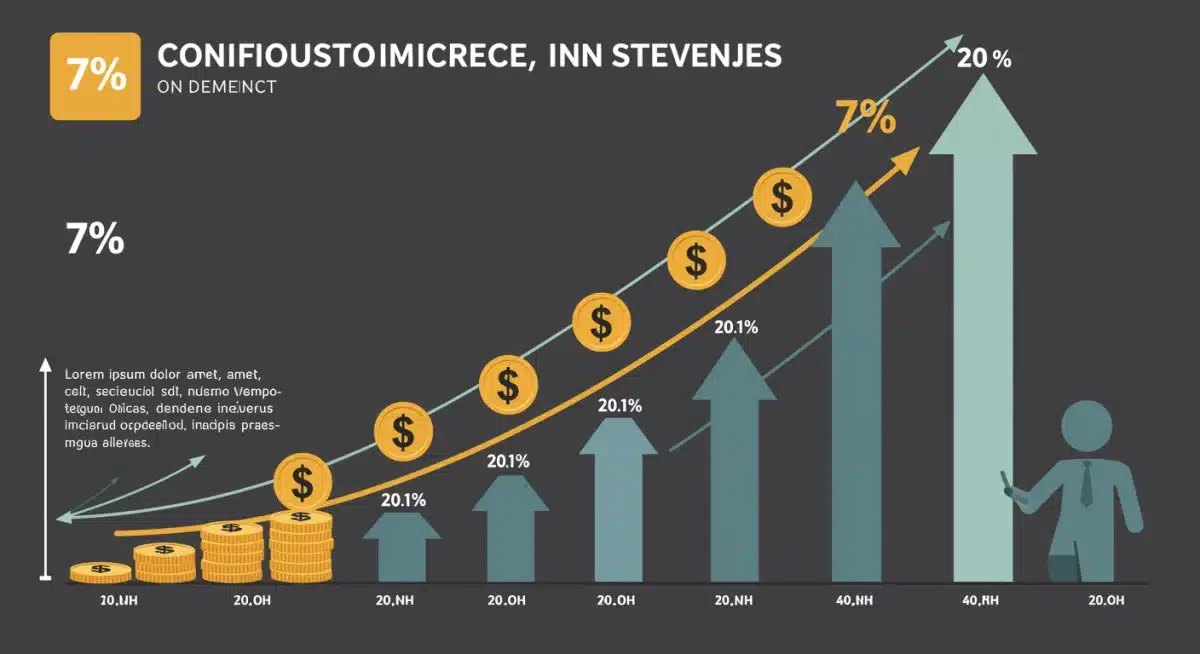
A 7% increase in your monthly retirement contributions might seem like a small adjustment, but its cumulative effect over several years can be profound. This seemingly modest boost leverages the power of compound interest, transforming small, consistent additions into substantial growth for your retirement nest egg. It’s about optimizing your savings rate to accelerate your financial goals without drastically altering your current lifestyle.
Consider the scenario where you’re contributing $500 per month. A 7% increase means adding an extra $35 per month. While $35 might not cover a fancy dinner, redirecting it consistently into your retirement account allows it to grow exponentially over time. This incremental approach is often more sustainable than trying to make a massive, sudden jump in contributions, making it a realistic strategy for many.
Compound Interest: Your Best Ally
Compound interest is the foundation of long-term wealth building, allowing your earnings to generate further earnings. The earlier you start increasing your contributions, the more time your money has to grow.
- Accelerated Growth: A 7% increase means more capital is exposed to compounding, leading to faster growth.
- Time Horizon: The longer your investment horizon, the greater the impact of compounding on even small increases.
- Market Returns: Consistent contributions, coupled with market returns, amplify the benefits of this strategy.
The tangible impact of this 7% increase extends beyond just the raw numbers. It instills financial discipline and provides a psychological boost, knowing you are actively taking control of your future. This small change can be the catalyst for a more secure and comfortable retirement, bridging a significant portion of your potential savings gap.
Strategies to Fund Your Increased Contributions
Finding an extra 7% for your retirement contributions doesn’t have to mean drastic sacrifices. Often, it involves re-evaluating existing spending habits and identifying areas where small adjustments can free up funds. The key is to approach this systematically, making conscious choices that align with your long-term financial goals without feeling overly restrictive in the present.
Many people discover that a detailed review of their monthly budget reveals surprising opportunities for savings. It could be as simple as cutting down on daily coffee purchases, optimizing subscriptions, or finding more cost-effective alternatives for regular expenses. The goal is to identify sustainable changes that won’t feel like a burden but rather a smart reallocation of resources.
Budgeting and Expense Optimization
A thorough budget review is the cornerstone of finding extra funds. Understanding where your money goes is the first step to controlling it.
- Track Spending: Utilize budgeting apps or spreadsheets to categorize and monitor all expenditures.
- Identify Non-Essentials: Pinpoint areas where spending can be reduced or eliminated without impacting quality of life.
- Automate Savings: Set up automatic transfers to your retirement account immediately after payday to ensure consistency.
Beyond cutting costs, consider avenues for increasing your income. This could involve negotiating a raise, taking on a side hustle, or monetizing a hobby. Any additional income, even if modest, can be directly channeled into your increased retirement contributions, making the 7% goal more attainable. The cumulative effect of these small financial shifts can be remarkably powerful.
Leveraging Employer-Sponsored Plans and IRAs
Maximizing your retirement savings often begins with fully utilizing the vehicles available to you, primarily employer-sponsored plans like 401(k)s and individual retirement accounts (IRAs). These plans offer significant tax advantages and, in the case of employer plans, often include matching contributions that are essentially free money. Failing to contribute enough to capture an employer match is leaving money on the table, directly hindering your retirement growth.
In 2026, contribution limits for these accounts are likely to have adjusted, making it even more important to be aware of the maximums. Increasing your contribution by 7% should first be directed towards capturing any employer match, then towards maximizing your contributions to these tax-advantaged accounts up to their legal limits. This dual approach ensures you’re benefiting from both employer generosity and tax efficiency.
Maximizing Your 401(k) Contributions
Employer-sponsored 401(k)s are a cornerstone of retirement planning for many, offering convenience and significant benefits.
- Employer Match: Always contribute at least enough to get the full employer match; it’s a guaranteed return on your investment.
- Contribution Limits: Be aware of the annual contribution limits for 2026 and strive to meet or exceed them.
- Pre-tax vs. Roth: Understand the tax implications of traditional (pre-tax) versus Roth 401(k) contributions and choose what best fits your financial situation.
Once you’ve maximized your 401(k), consider contributing to an IRA. Whether it’s a traditional or Roth IRA, these accounts offer additional tax benefits and a broader range of investment options. The 7% increase in contributions can be strategically split between these accounts to optimize your tax position and diversify your investment portfolio, ensuring a robust and well-rounded retirement strategy.
Investment Strategies for Enhanced Growth
Simply increasing your contributions is only one part of the equation; how those funds are invested plays an equally critical role in bridging your retirement gap. As we look at 2026, market conditions and investment opportunities continue to evolve, requiring a thoughtful approach to portfolio allocation. The goal is to achieve a balance between growth and risk that aligns with your timeline and risk tolerance.
For those with a longer time horizon until retirement, a more aggressive investment strategy with a higher allocation to equities might be appropriate, as it offers greater potential for growth to outpace inflation. Conversely, those closer to retirement may opt for a more conservative approach to protect their accumulated capital. The 7% increase in contributions provides additional capital to allocate according to your personalized investment strategy.
Diversification and Risk Management
A well-diversified portfolio is essential for mitigating risk and optimizing returns over the long term.
- Asset Allocation: Distribute your investments across various asset classes, such as stocks, bonds, and real estate.
- Global Diversification: Invest in both domestic and international markets to reduce exposure to any single economy.
- Regular Rebalancing: Periodically adjust your portfolio to maintain your desired asset allocation as market conditions change.
Consider consulting with a financial advisor to fine-tune your investment strategy. They can help you assess your risk tolerance, set realistic growth expectations, and select appropriate investment vehicles. The additional funds from your 7% contribution increase can be strategically deployed into these diversified investments, further accelerating your progress toward a secure retirement. Prudent investment choices amplify the impact of increased savings.
Monitoring Progress and Adjusting Your Plan Annually
Retirement planning is not a set-it-and-forget-it endeavor; it requires ongoing monitoring and periodic adjustments. As economic conditions shift, personal circumstances change, and market performance fluctuates, your retirement plan needs to be flexible enough to adapt. Establishing a routine for reviewing your progress, ideally on an annual basis, is crucial for staying on track and making necessary course corrections.
This annual review should involve assessing your current savings, comparing it against your goals, and evaluating the effectiveness of your investment strategy. Life events, such as a new job, marriage, or the birth of a child, can significantly impact your financial situation and necessitate adjustments to your contribution levels or investment choices. The 7% increase provides a solid foundation, but continuous evaluation ensures its effectiveness.
Key Metrics to Monitor
Regularly tracking key financial metrics helps you gauge your progress and identify areas for improvement.
- Savings Rate: Ensure your actual savings rate aligns with your target, including the 7% increase.
- Portfolio Performance: Evaluate how your investments are performing against benchmarks and your expectations.
- Retirement Projections: Use online calculators or financial planning tools to project your retirement readiness annually.
Don’t be afraid to adjust your plan if circumstances dictate. Perhaps you can increase your contributions even further, or maybe you need to temporarily scale back due to an unexpected expense. The important thing is to be proactive and informed. By consistently monitoring your progress and making informed adjustments, you ensure that your retirement planning in 2026 and beyond remains robust and responsive to your evolving needs, ultimately bridging any remaining gaps.
| Key Aspect | Brief Description |
|---|---|
| 7% Contribution Increase | A strategic, incremental boost to monthly retirement savings for substantial long-term growth. |
| Combatting Inflation | Increased savings help offset the erosion of purchasing power due to rising costs over time. |
| Leveraging Employer Match | Prioritize reaching employer match thresholds to maximize ‘free money’ for retirement. |
| Annual Review | Regularly assess and adjust your retirement plan to adapt to life changes and market conditions. |
Frequently Asked Questions About Retirement Planning in 2026
A 7% increase is often seen as a manageable yet impactful step that can be integrated into most budgets without significant hardship. It provides a noticeable boost to compounding without being overly aggressive, making it a sustainable strategy for bridging savings gaps by 2026 and beyond.
Inflation erodes the purchasing power of your money over time. What $100 buys today will cost more in 2026 and beyond. Therefore, your savings need to grow at a rate that outpaces inflation to maintain your desired lifestyle in retirement, making increased contributions vital.
Start by tracking all your expenses to identify areas for optimization. Consider cutting non-essential spending, negotiating bills, or exploring side income opportunities. Automating transfers to your retirement account ensures consistency once you identify the funds.
Generally, prioritize contributing enough to your 401(k) to get the full employer match first, as it’s free money. After that, you can consider maximizing contributions to an IRA (traditional or Roth) for additional tax benefits and investment flexibility, then return to maximize your 401(k).
It is advisable to review your retirement plan and contributions at least once a year. This allows you to account for changes in income, expenses, market performance, and personal life events, ensuring your plan remains aligned with your goals for retirement planning in 2026 and beyond.
Conclusion
Navigating the complexities of retirement planning in 2026 requires a proactive and strategic approach. By committing to a 7% increase in your monthly contributions, you are not just saving more; you are actively building a more secure and robust financial future. This seemingly small adjustment, when combined with smart investment strategies and consistent monitoring, can significantly bridge any existing savings gaps, providing peace of mind and the freedom to enjoy your golden years. Start today, assess your finances, and take that crucial step towards a well-deserved retirement.