
The Latest in Robo-Advisors for 2026: Comparing Fees and Performance for U.S. Investors Under $50,000
Welcome to 2026, where the landscape of personal finance continues its rapid evolution. For U.S. investors looking to grow their wealth, especially those with under $50,000 to invest, the options can seem daunting. Traditional financial advisors often come with high minimums and steep fees, making them inaccessible for many. This is where robo-advisors shine, offering sophisticated, automated investment management at a fraction of the cost. But with so many players in the market, how do you choose the best one? This comprehensive guide will delve into the latest trends in robo-advisors 2026 fees and performance, specifically tailored for investors with smaller portfolios.
The promise of robo-advisors is simple yet powerful: democratizing investing through technology. By leveraging algorithms, these platforms construct and manage diversified portfolios based on your financial goals, risk tolerance, and time horizon. They handle everything from asset allocation and rebalancing to tax-loss harvesting, all with minimal human intervention. This automation translates to significant cost savings, making them an ideal choice for new investors or those with limited capital. As we move further into 2026, the competition among these platforms is fiercer than ever, leading to continuous innovation and increasingly attractive offerings for consumers.
Our focus today is on helping U.S. investors with less than $50,000 navigate this dynamic environment. We’ll examine key factors like advisory fees, underlying investment costs (expense ratios), account minimums, and historical performance. Understanding these elements is crucial to making an informed decision that aligns with your financial aspirations. The goal is to find a platform that not only keeps robo-advisors 2026 fees low but also provides robust performance to help your money work harder for you.
Understanding Robo-Advisor Fee Structures in 2026
One of the primary attractions of robo-advisors is their cost-effectiveness compared to traditional financial advisors. However, it’s essential to understand the various components of robo-advisors 2026 fees to get a clear picture of your total investment costs. These fees typically fall into a few categories:
1. Advisory Fees (Management Fees)
This is the most direct fee you’ll pay to the robo-advisor for managing your portfolio. It’s usually expressed as an annual percentage of your assets under management (AUM). For portfolios under $50,000, these fees are generally quite competitive. In 2026, we’re seeing advisory fees for smaller accounts ranging from 0% to 0.50% annually. Some platforms offer tiered pricing, where the percentage decreases as your AUM grows, while others might have flat fees or even free options for very small balances.
- 0% Fees: A few platforms, often those associated with banking institutions or aiming for market share, might offer 0% advisory fees for balances below a certain threshold (e.g., $5,000 or $10,000). While attractive, it’s crucial to check for other potential costs.
- 0.25% – 0.35% Fees: This is a common range for many mainstream robo-advisors. For a $10,000 portfolio, a 0.25% fee would amount to just $25 per year, a very reasonable cost for professional management.
- 0.40% – 0.50% Fees: Some platforms offering more advanced features, access to human advisors, or specialized investment strategies might fall into this range. Even at 0.50%, a $50,000 portfolio would incur $250 in annual advisory fees, still significantly less than a traditional advisor.
When comparing robo-advisors 2026 fees, always look at the specific percentage applied to your expected portfolio size. A small difference in percentage can add up significantly over time, especially as your portfolio grows.
2. Expense Ratios of Underlying Investments
Beyond the advisory fee, you’ll also pay expense ratios on the exchange-traded funds (ETFs) or mutual funds that make up your portfolio. These are fees charged by the fund providers themselves, not directly by the robo-advisor, but they are an integral part of your total investment cost. Robo-advisors typically use low-cost ETFs, with average expense ratios often ranging from 0.05% to 0.20% per year. These are automatically deducted from the fund’s returns.
For example, if your portfolio consists of ETFs with an average expense ratio of 0.10%, and your advisory fee is 0.25%, your total annual cost would be approximately 0.35%. It’s vital to consider both components when evaluating the true cost of a robo-advisor. Many platforms are transparent about these underlying costs, and some even prioritize funds with ultra-low expense ratios to keep your overall costs down.
3. Other Potential Fees
While less common, some robo-advisors might have other fees to be aware of:
- Trading Fees/Commissions: Most reputable robo-advisors offer commission-free trading within their platforms. However, if you opt for a platform that allows individual stock trading or specialized investments outside the core portfolio, check for these.
- Account Minimum Fees: Some platforms might charge a small maintenance fee if your balance falls below a certain minimum, though this is becoming rarer, especially for platforms targeting smaller investors.
- Premium Service Fees: If you choose to upgrade to a plan that includes unlimited access to human financial advisors or more complex planning tools, expect a higher advisory fee.
The landscape of robo-advisors 2026 fees is highly competitive, pushing providers to offer more value for less. Always read the fine print and fee disclosures to ensure you understand all potential costs associated with your chosen platform.
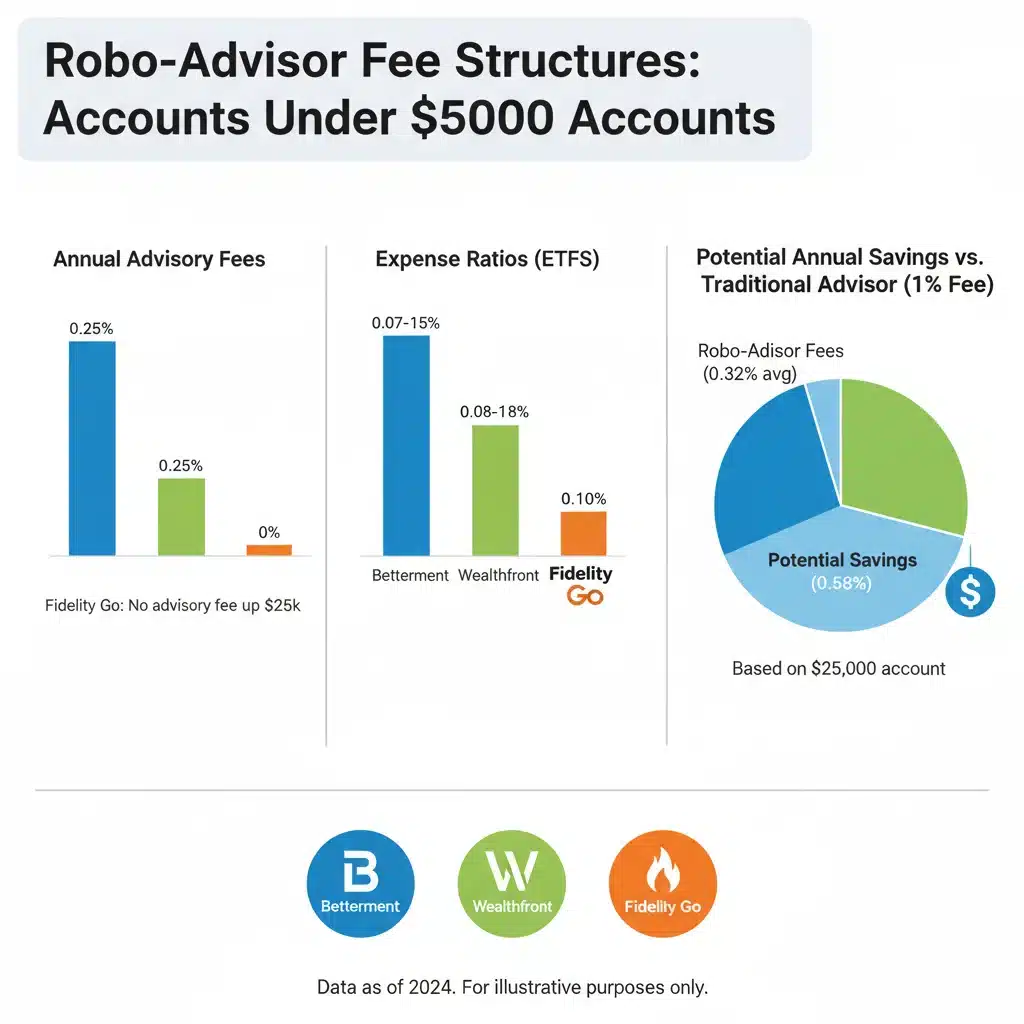
Key Robo-Advisors for Under $50,000 in 2026: Fees and Features
Now, let’s dive into some of the leading robo-advisors that are particularly well-suited for U.S. investors with under $50,000 in 2026, comparing their fee structures, account minimums, and standout features. Please note that while we strive for accuracy, fees and features can change, so always verify the latest information directly on the provider’s website.
1. Betterment
- Account Minimum: $0 to start.
- Advisory Fees: 0.25% per year for their Digital plan (no minimum AUM). For balances over $100,000, it remains 0.25%. A Premium plan (for balances over $100,000) with unlimited access to human advisors costs 0.40% per year.
- Underlying Investment Costs: Typically 0.05% – 0.15% average ETF expense ratios.
- Total Cost for <$50,000: Approximately 0.30% – 0.40% annually (0.25% advisory + ETF expense ratios).
- Key Features: Tax-loss harvesting (automatic), diversified portfolios (stocks, bonds, real estate, emerging markets), goal-based planning, flexible portfolio options (including socially responsible investing – SRI), fractional shares, and access to financial advisors for an additional fee or with the Premium plan. Betterment continues to be a top contender for robo-advisors 2026 fees and comprehensive features.
- Performance: Historically strong, with diversified portfolios designed to weather market fluctuations. Performance varies based on chosen risk level and market conditions.
Betterment remains a powerhouse in the robo-advisor space, especially for those starting with smaller amounts. Their $0 minimum and competitive 0.25% advisory fee make it highly accessible. The automatic tax-loss harvesting is a significant benefit, potentially saving investors hundreds or even thousands of dollars in taxes annually, effectively offsetting a portion of the advisory fee. Their goal-based planning tools are intuitive, helping users visualize progress towards retirement, a down payment, or other financial milestones.
2. Wealthfront
- Account Minimum: $500.
- Advisory Fees: 0.25% per year for all taxable accounts.
- Underlying Investment Costs: Typically 0.07% – 0.16% average ETF expense ratios.
- Total Cost for <$50,000: Approximately 0.32% – 0.41% annually (0.25% advisory + ETF expense ratios).
- Key Features: Sophisticated tax-loss harvesting (including stock-level tax-loss harvesting for larger accounts), diversified portfolios (ETFs across various asset classes), automated rebalancing, portfolio line of credit (for accounts over $25,000), Path financial planning tool, and cryptocurrency offerings. Wealthfront is known for its advanced algorithms and tax-efficiency strategies.
- Performance: Consistently strong, often cited for its robust tax-loss harvesting capabilities which can significantly boost after-tax returns.
Wealthfront is another excellent choice, particularly for investors who prioritize tax efficiency. Their 0.25% advisory fee is on par with Betterment, and their tax-loss harvesting is considered one of the best in the industry. The $500 minimum is still very low, making it accessible to most new investors. For those with a balance over $25,000, the portfolio line of credit can be a useful feature, offering liquidity without selling investments. Wealthfront’s Path planning tool also provides a holistic view of your finances, helping you plan for various life events.
3. Fidelity Go
- Account Minimum: $0 to open, $0 advisory fee for balances under $25,000, then $0 advisory fee for balances between $25,000 and $250,000.
- Advisory Fees: 0% for balances under $25,000. For balances between $25,000 and $250,000, the advisory fee is 0.35% per year.
- Underlying Investment Costs: Utilizes Fidelity Flex® ETFs with 0% expense ratios.
- Total Cost for <$25,000: 0% (advisory) + 0% (ETF expense ratios) = 0% annually.
- Total Cost for $25,000 – $50,000: 0.35% (advisory) + 0% (ETF expense ratios) = 0.35% annually.
- Key Features: Managed portfolios with 0% expense ratio ETFs, automatic rebalancing, goal-based planning, access to Fidelity’s extensive resources, and human advisor support for higher tiers. Fidelity Go stands out for its incredibly low robo-advisors 2026 fees, especially for smaller portfolios.
- Performance: Solid performance backed by Fidelity’s research and investment expertise, utilizing their proprietary funds.
Fidelity Go presents an incredibly compelling offer for investors with under $25,000, essentially offering free managed investing thanks to its 0% advisory fee and 0% expense ratio ETFs. This makes it an absolute winner for those just starting out. Even for balances between $25,000 and $50,000, the 0.35% advisory fee is competitive, especially considering the 0% expense ratios of the underlying funds. The integration with Fidelity’s broader ecosystem also provides access to a wealth of educational resources and customer support, a significant advantage for new investors.
4. Schwab Intelligent Portfolios
- Account Minimum: $5,000.
- Advisory Fees: 0% for the basic digital-only service.
- Underlying Investment Costs: Uses Schwab ETFs, third-party ETFs, and cash. Average ETF expense ratios are typically 0.05% – 0.15%. A significant portion of the portfolio (often 6-30%) is held in cash, which does not earn returns.
- Total Cost for <$50,000: Approximately 0.05% – 0.15% annually (ETF expense ratios) + opportunity cost of cash drag.
- Key Features: Diversified portfolios, automatic rebalancing, tax-loss harvesting (for taxable accounts over $50,000), access to human advisors (with Schwab Intelligent Portfolios Premium for a one-time planning fee and a monthly advisory fee for balances over $25,000). The 0% advisory fee is a major draw, but the cash allocation needs consideration.
- Performance: Generally strong, but the cash allocation can sometimes dampen returns in bull markets.
Schwab Intelligent Portfolios offers a unique proposition with its 0% advisory fee. This makes its robo-advisors 2026 fees extremely attractive on the surface. However, it’s crucial to understand their strategy of holding a significant cash allocation within the portfolio. While this provides a safety net during market downturns, it can also lead to underperformance during strong bull markets due to the ‘cash drag.’ For investors comfortable with this approach and seeking a truly free advisory service (excluding ETF expense ratios), Schwab is a solid option, especially given their robust parent company support.
5. M1 Finance
- Account Minimum: $100 for taxable accounts, $500 for retirement accounts.
- Advisory Fees: 0% for their basic M1 Invest offering.
- Underlying Investment Costs: Utilizes ETFs with average expense ratios typically 0.06% – 0.20%.
- Total Cost for <$50,000: Approximately 0.06% – 0.20% annually (ETF expense ratios).
- Key Features: ‘Pies’ for customized portfolio creation (choose individual stocks and ETFs), automated rebalancing, fractional shares, M1 Spend (checking account), M1 Borrow (portfolio line of credit for accounts over $5,000). M1 Finance is ideal for investors who want more control over their investments while still benefiting from automation, offering competitive robo-advisors 2026 fees.
- Performance: Depends heavily on the user’s chosen ‘pie’ (portfolio allocation). Can range from market-matching to outperforming/underperforming based on individual stock/ETF selections.
M1 Finance stands out for its blend of automation and customization. While it’s a robo-advisor, it gives users the freedom to select specific stocks and ETFs to build their own ‘pies’ (portfolios). This makes it perfect for investors who have a strong opinion about certain companies or sectors but still want the benefits of automated rebalancing and cost-efficiency. The 0% advisory fee is a major draw, making it one of the most affordable options if you’re comfortable with building your own investment strategy within their framework. The M1 ecosystem also offers banking and lending features, creating a comprehensive financial hub.

Analyzing Performance: What to Look For
While low robo-advisors 2026 fees are important, performance is equally critical. It’s not just about how much you save on fees, but how much your money actually grows. When evaluating robo-advisor performance, consider these points:
1. Historical Returns vs. Benchmarks
Most robo-advisors invest in diversified portfolios of ETFs, which are designed to track various market indices (benchmarks) like the S&P 500 for U.S. large-cap stocks or the Bloomberg Aggregate Bond Index for bonds. Look for platforms that can demonstrate returns that are competitive with or slightly exceed their chosen benchmarks for a given risk level. Remember that past performance is not indicative of future results, but it does offer insight into the effectiveness of their investment strategy and rebalancing algorithms.
2. Risk-Adjusted Returns
A high return isn’t always good if it comes with excessively high risk. Look for robo-advisors that offer strong risk-adjusted returns. This means they are generating good returns relative to the amount of risk taken. Metrics like the Sharpe Ratio or Sortino Ratio, while more advanced, can be helpful in this assessment. Most robo-advisors will provide data on how their portfolios performed across different risk profiles (e.g., conservative, moderate, aggressive).
3. Tax-Loss Harvesting Impact
For taxable accounts, the effectiveness of tax-loss harvesting can significantly impact your after-tax returns. Platforms like Betterment and Wealthfront are leaders in this area. While it might not show up directly in a ‘gross performance’ number, the tax savings can be a substantial boost to your net returns, especially during volatile market years. When comparing robo-advisors 2026 fees and performance, don’t overlook this crucial feature.
4. Diversification Strategy
A well-diversified portfolio is the cornerstone of long-term investing. Ensure the robo-advisor allocates your money across various asset classes (U.S. stocks, international stocks, U.S. bonds, international bonds, real estate, etc.) and uses a broad selection of low-cost ETFs. This reduces reliance on any single asset and helps smooth out returns over time.
It’s important to set realistic expectations. Robo-advisors are designed for long-term growth, not get-rich-quick schemes. Their performance will largely mirror the broader market, adjusted for your specific risk tolerance and asset allocation.
Choosing the Right Robo-Advisor for Your Under $50,000 Portfolio
With a clearer understanding of robo-advisors 2026 fees and performance considerations, how do you make the final decision? Here’s a step-by-step approach for U.S. investors with under $50,000:
1. Define Your Financial Goals and Risk Tolerance
Before looking at any platform, know what you’re saving for (retirement, house down payment, general wealth growth) and your comfort level with market fluctuations. This will dictate your portfolio’s risk level (conservative, moderate, aggressive) and help the robo-advisor construct an appropriate allocation.
2. Assess Your Initial Investment Amount
While all the mentioned robo-advisors cater to smaller investors, their minimums vary. Fidelity Go is excellent for very small starting amounts ($0 for under $25k), while Schwab requires $5,000. M1 Finance has low minimums but offers more control. Match your starting capital to a platform’s minimum requirements.
3. Compare Total Costs (Advisory Fees + Expense Ratios)
Don’t just look at the advisory fee. Add the estimated average expense ratios of the underlying ETFs to get a true picture of your total annual cost. For example, Fidelity Go’s 0% advisory fee for under $25,000 plus 0% ETF expense ratios means truly free managed investing for that tier. For a $30,000 portfolio, Fidelity Go’s 0.35% total cost might be more appealing than Betterment’s 0.25% advisory + 0.10% ETF = 0.35% total, depending on specific ETF choices.
4. Evaluate Key Features and Services
- Tax-Loss Harvesting: If you’re investing in a taxable brokerage account, this feature can be a game-changer. Betterment and Wealthfront excel here.
- Access to Human Advisors: Do you want the option to speak with a human financial planner? Some platforms offer this as an add-on or with higher-tier plans.
- Customization: Do you want more control over your investments (like M1 Finance) or prefer a fully automated, hands-off approach?
- Goal Planning Tools: Are the planning tools intuitive and helpful for tracking your progress?
- SRI Options: If socially responsible investing is important to you, check which platforms offer dedicated SRI portfolios.
5. Read Reviews and User Experiences
While our guide provides a solid overview, reading recent user reviews and checking out financial news outlets for their latest assessments of robo-advisors 2026 fees and services can offer additional perspectives.
The Future of Robo-Advisors for Small Investors in 2026 and Beyond
The trend towards lower fees and more sophisticated features for smaller investors is set to continue. As technology advances and competition intensifies, we can expect:
- Even Lower Fees: The race to the bottom on fees might slow, but providers will continue to find innovative ways to offer value, potentially through bundling services or offering more free tiers. The competitive landscape for robo-advisors 2026 fees is fierce, benefiting consumers.
- Enhanced Personalization: AI and machine learning will allow for even more tailored portfolios and financial advice, moving beyond basic risk questionnaires to incorporate more nuanced aspects of an investor’s life.
- Broader Investment Options: Expect more access to alternative investments, cryptocurrency, and perhaps even direct indexing for smaller portfolios, which traditionally were only available to high-net-worth individuals.
- Seamless Integration: Robo-advisors will become even more integrated with banking, budgeting, and other financial tools, offering a holistic view and management of your entire financial life.
- Hybrid Models: The combination of automated investing with access to human financial planners will become more prevalent, offering the best of both worlds for those who want a blend of technology and personal guidance.
For U.S. investors with under $50,000, 2026 presents an exciting time to engage with automated investing. The barriers to entry are lower than ever, and the tools available are more powerful and cost-effective. By carefully comparing robo-advisors 2026 fees, performance, and features, you can set yourself on a strong path toward achieving your financial goals.
Conclusion: Maximizing Your Investment Potential with Robo-Advisors
Investing doesn’t have to be complicated or expensive, especially with the advancements in robo-advisor technology. For U.S. investors starting with under $50,000, 2026 offers a wealth of excellent options that combine low fees with robust performance and intelligent features. Platforms like Betterment, Wealthfront, Fidelity Go, Schwab Intelligent Portfolios, and M1 Finance each bring unique strengths to the table, catering to different preferences and priorities.
The key is to perform your due diligence: understand the total cost, assess the features that matter most to your financial journey, and choose a platform that aligns with your goals and risk tolerance. By doing so, you can harness the power of automated investing to build and grow your wealth efficiently, without the prohibitive costs often associated with traditional financial advice. Embrace the future of investing and let a top robo-advisor work for you in 2026 and beyond.