
Mastering Micro-Credentials: Why 3-Month Programs Are the Future of U.S. Workforce Development
The landscape of education and employment in the United States is undergoing a profound transformation. Traditional four-year degrees, while still valuable, are increasingly being complemented, and in some cases, challenged, by more agile and focused educational pathways. Among these, **micro-credentials workforce development** programs, particularly those designed to be completed in as little as three months, are emerging as a powerful force reshaping how individuals acquire skills and how industries address critical talent gaps. This article delves into the burgeoning world of micro-credentials, exploring why these short-term, targeted programs are not just a trend, but a fundamental shift in the future of U.S. workforce development.
The Evolving Demands of the Modern Workforce
The pace of technological advancement, coupled with global economic shifts, has created an unprecedented demand for continuous learning and skill adaptation. Industries are constantly evolving, requiring employees to possess a dynamic toolkit of competencies. What was cutting-edge knowledge five years ago might be foundational today, and obsolete tomorrow. This rapid evolution has exposed significant skill gaps across various sectors, from advanced manufacturing and cybersecurity to healthcare and data analytics.
Traditional higher education systems, designed for comprehensive, multi-year programs, often struggle to keep pace with these swift changes. The lengthy duration and broad scope of conventional degrees, while offering deep foundational knowledge, can sometimes be too slow or too general to meet immediate industry needs. This is where **micro-credentials workforce development** steps in, offering a nimble and responsive solution.
What Exactly Are Micro-Credentials?
At their core, micro-credentials are verified certifications of specific skills or competencies. Unlike a degree, which attests to a broad body of knowledge, a micro-credential validates mastery of a very particular skill set. Think of them as digital badges or certificates that confirm an individual’s proficiency in a niche area, such as Python programming, cloud computing fundamentals, digital marketing analytics, or advanced project management techniques.
These programs are typically:
- Focused: Targeting a single, well-defined skill or a cluster of closely related skills.
- Short-term: Often completed in weeks or a few months, with 3-month programs being particularly popular for their balance of depth and speed.
- Competency-based: Emphasizing practical application and demonstrated mastery over seat time.
- Stackable: Designed to be combined with other micro-credentials or even traditional degrees, building a comprehensive skill profile.
- Industry-relevant: Developed in close collaboration with employers to ensure the skills taught are directly applicable to current job market demands.
The appeal of 3-month **micro-credentials workforce development** programs lies in their ability to provide rapid, targeted upskilling or reskilling opportunities. For individuals, this means faster entry into new roles or quicker advancement within their current careers. For employers, it means a more agile talent pool capable of responding to evolving business needs without the long lead times associated with traditional education.
The Power of 3-Month Programs: Speed, Relevance, and Accessibility
The specific timeframe of three months for micro-credential programs is not arbitrary; it strikes a crucial balance. It’s long enough to impart meaningful, employable skills, but short enough to be highly accessible and appealing to a wide range of learners, including:
- Working Professionals: Those looking to upskill for a promotion or pivot careers without taking extended time off work.
- Unemployed or Underemployed Individuals: Seeking a fast track to in-demand jobs.
- Recent Graduates: Aiming to supplement their degrees with specialized skills that make them more competitive.
- Career Changers: Individuals looking to transition into entirely new fields with minimal time and financial commitment.
The speed of these programs is a game-changer. In a world where technology advances yearly, waiting four years for a degree to become job-ready can mean missing out on crucial opportunities. Three-month programs allow individuals to acquire relevant skills and enter the workforce or advance their careers much more quickly, making them highly attractive in today’s fast-paced environment.
Addressing the Skill Gap with Precision
The U.S. economy faces a persistent skill gap, with millions of job openings going unfilled due to a lack of qualified candidates. This is particularly true in tech-driven fields. **Micro-credentials workforce development** programs are uniquely positioned to bridge this gap. By focusing on specific, in-demand skills identified directly by industries, these programs ensure that learners are acquiring competencies that employers desperately need. For example, a three-month program in data visualization with Tableau or cloud security with AWS can directly equip an individual with the exact skills required for numerous open positions.
This precision training minimizes wasted time and resources, both for the learner and the employer. It moves away from a one-size-fits-all education model towards a modular, customizable approach that is far more responsive to market demands.
Benefits for Individuals: A New Path to Career Mobility
For individuals, embracing **micro-credentials workforce development** offers a multitude of advantages that can significantly impact their career trajectories:
- Rapid Skill Acquisition: The most obvious benefit is the ability to quickly gain highly marketable skills. This means faster entry into new roles or quicker eligibility for promotions.
- Increased Employability: Employers are increasingly looking for specific skills, and micro-credentials provide clear, verifiable proof of these competencies. This makes candidates more attractive in competitive job markets.
- Cost-Effectiveness: Compared to a full degree, micro-credential programs are significantly more affordable, reducing the financial barrier to education and upskilling.
- Flexibility and Accessibility: Many micro-credential programs are offered online or in hybrid formats, making them accessible to individuals with varying schedules and geographical locations.
- Career Pivoting: For those looking to change careers, micro-credentials offer a lower-risk, faster way to test the waters and acquire foundational skills for a new field without committing to a multi-year degree.
- Lifelong Learning: They foster a mindset of continuous learning, enabling individuals to regularly update their skills throughout their careers to remain relevant and competitive.
- Validation and Recognition: A formal micro-credential provides external validation of skills, which can be easily shared on professional networks and resumes.
Imagine a marketing professional wanting to specialize in SEO. Instead of a full master’s degree, a 3-month micro-credential in advanced SEO techniques provides the precise skills needed to excel in that niche, directly impacting their job performance and career prospects.

Benefits for Employers and Industries: Building an Agile Workforce
The advantages of **micro-credentials workforce development** extend equally, if not more, to employers and entire industries:
- Targeted Talent Development: Companies can invest in micro-credentials to upskill their existing workforce in areas directly relevant to their strategic goals, rather than relying on generic training.
- Faster Onboarding: New hires with specific micro-credentials often require less extensive onboarding and can become productive more quickly.
- Reduced Recruitment Costs: By training existing employees or hiring individuals with verified micro-credentials, companies can reduce the time and cost associated with finding specialized talent.
- Increased Workforce Agility: An agile workforce capable of rapidly acquiring new skills is better equipped to adapt to market changes, technological disruptions, and evolving customer demands.
- Enhanced Employee Retention: Investing in employee development through micro-credentials can boost morale, job satisfaction, and loyalty, leading to higher retention rates.
- Addressing Specific Project Needs: For short-term projects requiring highly specialized skills, micro-credentials allow companies to quickly train or hire individuals with the exact competencies needed, without the overhead of full-time, broadly skilled employees.
- Innovation and Competitiveness: A workforce that is continuously learning and adapting new skills is more innovative and better positioned to maintain a competitive edge in the global marketplace.
For example, a manufacturing company transitioning to industry 4.0 technologies might offer its existing technicians 3-month micro-credential programs in robotics programming or industrial IoT, ensuring their workforce remains relevant and productive.
The Role of Educational Institutions and Industry Partnerships
The success of **micro-credentials workforce development** relies heavily on strong partnerships between educational institutions (colleges, universities, vocational schools) and industry leaders. These collaborations ensure that the skills taught are truly aligned with employer needs and that the curriculum is current and relevant.
Community colleges, in particular, are at the forefront of this movement. Their inherent flexibility and mission to serve local communities make them ideal incubators for rapid-response micro-credential programs. Many universities are also recognizing the value and are integrating micro-credentials into their offerings, either as standalone programs or as pathways to credit for full degrees.
Industry associations and tech companies are also playing a crucial role by developing their own certification programs (e.g., Google IT Support Professional Certificate, Salesforce Administrator Certification) or partnering with educators to co-create curricula. This symbiotic relationship ensures a robust ecosystem for micro-credential delivery and recognition.
Challenges and Considerations for Widespread Adoption
While the benefits are clear, widespread adoption of **micro-credentials workforce development** also faces certain challenges:
- Recognition and Standardization: Ensuring consistent quality and widespread recognition of micro-credentials across different industries and employers is crucial. Efforts are underway to develop common frameworks and standards.
- Funding Models: Developing sustainable funding models for these programs, including government support, employer sponsorship, and individual payments, is important for accessibility.
- Quality Assurance: Maintaining high-quality instruction and rigorous assessment methods is paramount to ensure the value and credibility of micro-credentials.
- Awareness and Acceptance: Educating both individuals and employers about the value and legitimacy of micro-credentials is an ongoing effort.
- Stackability and Pathways: Clearly defined pathways for stacking micro-credentials into larger qualifications or even degree credits are essential to maximize their long-term value.
Addressing these challenges will be key to unlocking the full potential of micro-credentials in shaping the U.S. workforce of the future. The conversation needs to shift from ‘degree vs. micro-credential’ to ‘how can degrees and micro-credentials complement each other to create the most skilled and adaptable workforce?’
Real-World Impact: Success Stories and Future Outlook
The impact of **micro-credentials workforce development** is already visible. Numerous individuals have successfully transitioned into high-demand tech roles after completing short-term bootcamps or certificate programs. Companies report improved productivity and innovation from employees who have undergone targeted upskilling through micro-credentials.
For instance, a person working in retail might complete a 3-month program in basic coding or data entry automation and secure a junior analyst position with significantly higher pay and career growth potential. An experienced manager might take a micro-credential in agile project management to lead a new team effectively. These are not isolated incidents but increasingly common pathways.
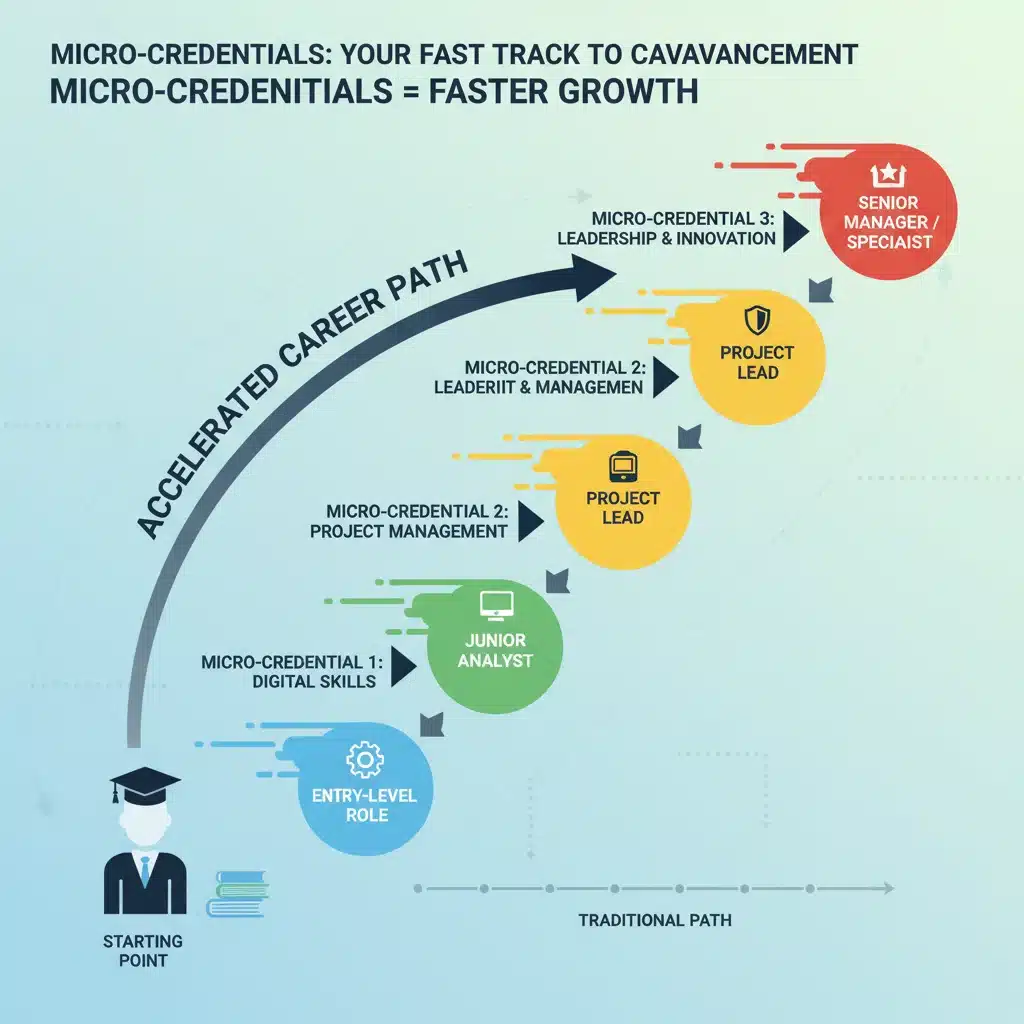
Looking ahead, the role of micro-credentials is only expected to grow. As artificial intelligence and automation continue to reshape industries, the need for humans to acquire uniquely human skills (like critical thinking, creativity, complex problem-solving) and constantly adapt to new technologies will intensify. Micro-credentials offer the perfect vehicle for this continuous adaptation.
The future of U.S. workforce development will likely be characterized by a blended learning ecosystem, where traditional degrees provide foundational knowledge and critical thinking, while micro-credentials offer the agile, just-in-time skill acquisition needed to thrive in a dynamic economy. This hybrid approach promises to create a more resilient, adaptable, and highly skilled workforce, capable of meeting the challenges and seizing the opportunities of the 21st century.
Conclusion: Embracing the Micro-Credential Revolution
The rise of 3-month **micro-credentials workforce development** programs signifies a pivotal moment in American education and employment. These focused, flexible, and fast-paced learning opportunities are democratizing skill acquisition, providing direct pathways to in-demand jobs, and empowering both individuals and industries to navigate the complexities of the modern economy. By offering a responsive solution to the ever-present skill gap, micro-credentials are not just supplementing traditional education; they are actively shaping the future of how we learn, work, and grow. Embracing this revolution is essential for anyone looking to stay competitive, relevant, and successful in the evolving U.S. workforce.